4-Week Home Workout Plan: Minimal Gear, Daily Stretches
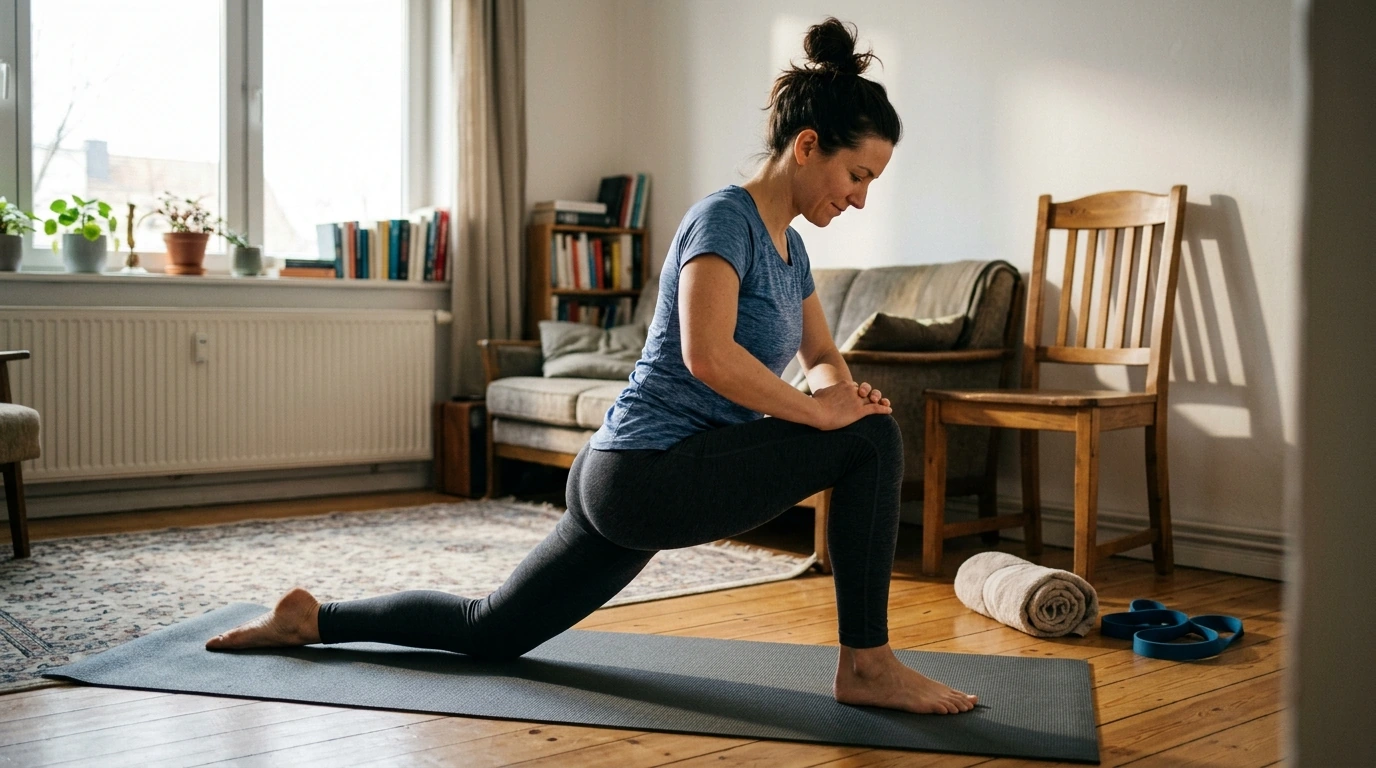
Fit at Home: A 4-Week Minimal-Equipment Workout Plan (Daily Workouts + Stretches)
A consistent routine beats a complicated routine—especially when space, time, and equipment are limited. This four-week plan is built for apartments, living rooms, hotel rooms, and busy calendars. Expect short, repeatable sessions that blend strength, cardio, and mobility using mostly bodyweight, with optional add-ons like resistance bands, a light dumbbell pair, or even a loaded backpack. Each day follows the same simple rhythm: warm up, work, train your core, then stretch so you’re ready to show up again tomorrow.
For general health targets, national recommendations suggest adults aim for regular aerobic activity plus muscle-strengthening work each week. Helpful references include the Physical Activity Guidelines for Americans and the CDC’s weekly activity guidance.
What This 4-Week Plan Is Designed to Improve
- Full-body strength using foundational patterns: squat/lunge, hinge, push, pull, and bracing.
- Cardio and work capacity through low-equipment circuits and intervals that scale up or down.
- Mobility and flexibility via short daily stretch blocks for hips, shoulders, and spine.
- Habit-building with a repeatable weekly structure and straightforward progressive overload.
- Confidence from clear cues, substitutions, and intensity options for different fitness levels.
Minimal Equipment Setup (and Easy Substitutes)
You can complete the full plan with common household items. A sturdy chair/bench, a towel, a clear wall space, and a yoga mat (or carpet) cover most needs. Optional upgrades—bands, mini-bands, light dumbbells, a jump rope, or sliders—simply make progressions easier to load.
Equipment Options by Workout Type
| Workout type | No equipment | Optional add-on | Simple substitute |
|---|---|---|---|
| Strength circuits | Bodyweight squats, push-ups, glute bridges | Bands or dumbbells | Backpack loaded with books |
| Cardio intervals | Marching/high knees, step-ups, shadow boxing | Jump rope | Stair step or sturdy platform |
| Core & mobility | Planks, dead bugs, hip openers | Mini-band | Towel for assisted stretches |
| Lower-body focus | Split squats, wall sits | Dumbbells | Water jugs or a loaded tote |
How the Weekly Structure Works
- 5 workout days + 2 recovery-focused days (or 4 + 3 if that’s more realistic).
- Repeatable “day types” so movement quality improves before volume rises.
- 20–40 minutes per session including warm-up and stretching.
- Effort guidance (RPE): most work sets feel like 6–8/10—challenging, but repeatable.
- Progression: add reps first, then rounds/sets, then resistance or harder variations.
To keep strength work aligned with best practices, the American College of Sports Medicine offers a useful overview of resistance training principles here: ACSM: Resistance Training for Health and Fitness.
4-Week Schedule at a Glance (Example Framework)
- Day 1: Full-body strength (push + legs + core)
- Day 2: Cardio + core (intervals) + stretch
- Day 3: Lower body + glutes (hinge + unilateral work)
- Day 4: Active recovery (mobility flow + easy walk) or full rest
- Day 5: Upper body + posture (push/pull balance) + core
- Day 6: Conditioning circuit (full-body) + longer stretching
- Day 7: Rest and reset (light movement encouraged)
Weeks 1–4 gradually increase volume or difficulty. A typical path is 2 rounds in Week 1, 3 rounds in Week 2, higher reps or tighter work/rest timing in Week 3, and harder variations or added load in Week 4.
Daily Session Blueprint (Use This for Every Workout Day)
- Warm-up (5–7 minutes): marching or step-ups, arm circles, hip hinges, bodyweight squats.
- Main block (12–25 minutes): strength sets or a timed circuit; keep form crisp.
- Core (3–8 minutes): plank/dead bug/side plank/bird dog emphasis.
- Cool-down (5–10 minutes): nasal breathing and longer holds for hips, hamstrings, chest, and lats.
- Tracking: jot down rounds/reps, the hardest variation used, and a quick effort rating.
Stretch Routine Staples (Post-Workout or Evening)
- Lower body: kneeling hip flexor stretch, figure-4 glute stretch, towel-assisted hamstring stretch, calf stretch at wall.
- Upper body: doorway chest stretch, lat stretch (child’s pose reach), thoracic rotations (“open books”).
- Spine and breathing: cat-cow plus crocodile breathing or 90/90 breathing to downshift.
- Hold times: 20–45 seconds; repeat tighter areas 2–3 times.
- Comfort rule: mild-to-moderate tension only—avoid sharp pain, numbness, or joint pinching.
Scaling the Plan for Beginners and Advanced Lifters
Beginner-friendly swaps
- Incline push-ups (hands on a chair or counter) instead of floor push-ups.
- Box squats to a chair to dial in depth and control.
- Shorter intervals and longer rest; fewer rounds while technique improves.
Advanced progressions
- Tempo reps (3 seconds down), pauses, and unilateral variations.
- Add load with bands, dumbbells, or a backpack for squats, hinges, and rows.
- Turn steady circuits into interval work by tightening rest periods.
If soreness or fatigue spikes, keep the movement pattern but cut volume 25–40% for one session. Consistency stays intact without digging a recovery hole.
Safety, Form Checks, and Consistency Tips
Digital Guides to Keep You On Track
- Fit at Home: 4-Week Workout Plan (PDF) for day-by-day workouts, progressions, and built-in stretching.
- Memory Boost Worksheets for Students & Adults to support focus, routines, and follow-through with quick printable exercises.
- A Guide to Safe Space Mapping to help design a calmer, more usable home environment—including a dedicated workout corner.
FAQ
How long are the daily workouts?
Most sessions take about 20–40 minutes including warm-up and stretching. On busy days, a 15–20 minute version works well by doing the warm-up, one main circuit, and a quick 3-minute stretch.
Do any of the workouts require equipment?
No—most workouts can be done with bodyweight and common household items like a chair and towel. Optional bands, dumbbells, or a loaded backpack can increase difficulty when you’re ready to progress.
Can this plan help with weight loss?
It can support weight loss by increasing weekly activity, boosting calorie burn, and helping maintain muscle as fitness improves. Results still depend heavily on nutrition, sleep, stress, and consistency over time.












Leave a comment